

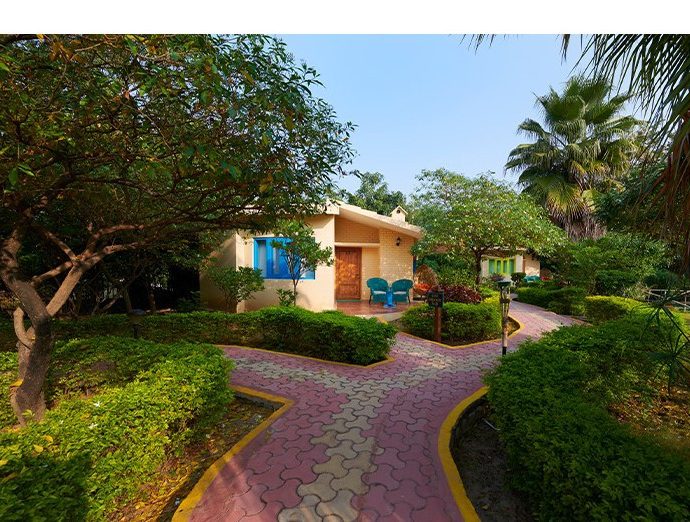
There is no single best month to visit Corbett, which is unsatisfying and true. What there is, is a clear trade-off between comfort, sighting odds, crowds and price. Once you know which of those matters most, the month picks itself.
October to November: the reopening
The core zones reopen after the monsoon and the forest is still green from the rain. Mornings are mild, the light is soft, and the crowds have not fully arrived. Migratory birds begin appearing through November, which starts the serious birding window.
The trade-off is thick undergrowth after months of rain, so sightlines are short and animals are hard to spot even when close. Excellent for landscape. Less so for tigers.
December to February: cold and clear
The most comfortable stretch of the year and the best for birding. Mornings are genuinely cold, and guests routinely underestimate how cold an open jeep at six is when you have just walked out of a heated room. Bring more layers than you think, including something for your ears.
Deer and elephant are easy to find and the air is clear enough to see the foothills sharp on the horizon. Tiger sightings happen but are less reliable, because water is everywhere and animals have no reason to be predictable.
March to mid-June: the sighting window
If your single goal is a tiger, this is your season. As heat builds, water shrinks, animals concentrate around what remains, and guides know where that is. Sighting rates climb from March and peak in May and early June.
The cost is heat. By May an afternoon slot is an endurance test, so morning drives become non-negotiable. The compensation is thinner undergrowth and much longer sightlines.
July to September: the monsoon
The core zones close for breeding season. Dhela and Jhirna stay open — which is the zone we share a boundary with. This is the season most travel content tells you to avoid, and most travel content is wrong about it.
What you get: a spectacularly green forest, rivers running full, almost nobody else on the property, and the most reasonable rates of the year. What you give up: the famous zones, and certainty about whether an afternoon stays dry.
The short version
- Birding and comfort: December to February
- Best tiger odds: April to mid-June
- Green, quiet, good value: July to September, Dhela and Jhirna only
- A balance of everything: late October to November, or March
One thing worth saying plainly
No season guarantees a tiger, and anyone who tells you otherwise is selling something. Corbett has a healthy population and good sighting rates by Indian standards, but it is a forest rather than an enclosure. Guests who arrive wanting to see a forest have a good morning regardless. The ones who come back are almost always in that group.
From the journal

Safari
Dhela, Jhirna or Bijrani: which Corbett zone should you book?
Six zones, each with a different character, season and reputation. A practical comparison from the resort that shares a boundary with Dhela.
Read
Safari
How to book a Jim Corbett safari permit without getting it wrong
Permits are the part of a Corbett trip that goes wrong most often. What the department needs, when to send it, and the mistakes that cost people their slot at the gate.
Read
Travel
Delhi to Jim Corbett by road: the drive, honestly
Five to six hours from Delhi, one genuinely slow stretch that decides the whole journey, and a final two kilometres of narrow road that nobody warns you about.
ReadBook direct, stay better
Best available rate, breakfast for everyone in the room, first pick of the forest-facing stays, and a safari desk that actually gets the permit.